
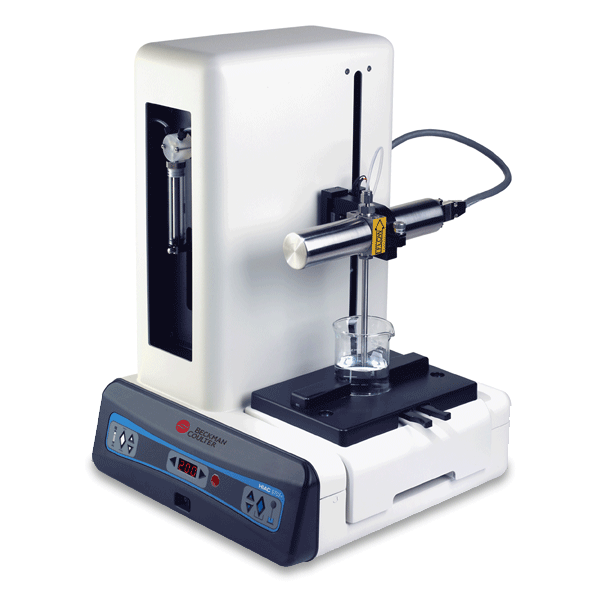
HIAC 液体颗粒计数器
使用 HIAC 液体颗粒计数器获取更加准确,稳定的液体粒子监测结果
20 世纪 60 年代初,在 HIAC(高精度产品的缩写)Leon D. Carver 和他的团队发明了光阻法,颗粒计数这个术语由此诞生。HIAC 是世界上第一家将激光作为光阻传感器的光源的公司。在过去的 60 年里,HIAC 品牌不断创新,是实验室中液体粒子计数的基准选择。
*本产品仅供工业与科研使用,不用于临床诊断
FAQ on Liquid Particle Counters
What are USP <788> and European Pharmacopeia 2.9.19 particulate matter tests?
USP <788> and European Pharmacopeia (Ph. Eur.) 2.9.19 are a pharmaceutical standard that define requirements for measuring visible and subvisible particulate matter in injectable drug products These standards establish particle count limits and approved test methods to help ensure product quality and safety. Liquid particle counters are commonly used to perform particle count testing and support regulatory compliance.
What is a liquid particle counter?
A liquid particle counter is an analytical instrument used to detect, size, and count particles suspended in liquids. These systems are commonly used in pharmaceutical manufacturing, water testing, and contamination control programs.
What are liquid particle counters used for in pharmaceutical manufacturing?
Liquid particle counters are used to monitor particulate contamination in injectable drugs, biologics, parenteral products, and pharmaceutical process fluids. They help support quality control programs and particulate matter testing requirements such as USP <788>.
What is light obscuration particle counting?
Light obscuration particle counting is a measurement method that uses a laser light source to detect and size particles suspended in a liquid. It is one of the most widely used techniques for pharmaceutical particulate testing and fluid contamination analysis.
What is the difference between liquid and air particle counters?
Liquid particle counters measure particles suspended in fluids, while air particle counters measure airborne particles within a defined volume of air. Both technologies support contamination monitoring but are designed for different sample types and applications.
How does a liquid particle counter work?
Most liquid particle counters use light obscuration technology. As particles pass through a laser beam, they block a portion of the light. The instrument measures these changes to determine particle size and concentration.


